

Oct 2026 Why Professional Painters Use Sprayers
Table of Contents
- Why Professional Painters Choose Sprayers
- Paint Sprayer vs Roller: Speed and Efficiency
- When to Use a Paint Sprayer on Your Project
- Finish Quality: What Professionals Achieve With Sprayers
- Paint Sprayer Preparation and Masking: The Foundation
- Spray Painting Kitchen Cupboards: Precision and Durability
- The Real Cost-Benefit: Labour Time and Paint Consumption
- Frequently Asked Questions
Last Updated: October 9, 2026
Why Professional Painters Choose Sprayers
At The Colour Palette, we’ve spent over 20 years watching what separates a rushed job from a pristine finish.
Sprayers aren’t just faster. They deliver a thinner, more even, more durable film than most rollers and brushes, visible the moment paint dries on kitchen cupboards, feature walls, and large commercial spaces.
But sprayers aren’t magic. They require proper preparation, correct masking, and technique. Get those wrong and you’ll waste paint, create overspray chaos, and end up with a finish worse than brush application.
Here’s why professionals reach for sprayers, when they use them, and what to know before deciding if one is right for your project.
Paint Sprayer vs Roller: Speed and Efficiency
A roller is faster for small, flat walls in an empty room.
The difference shows on vertical surfaces, textured walls, and anywhere you need precision.
But speed isn’t just about the spray itself. It’s about total job time.
Setup and preparation take longer with a sprayer:
- Masking off windows, trim, and fixtures
- Protecting floors and furniture thoroughly
- Taping edges and corners
Cleanup also takes longer:
- Flushing the sprayer system
- Removing protective coverings
- Cleaning overspray from surfaces nearby
On a small bedroom, these extra steps might make a roller faster overall.
Professional painters choose sprayers because they understand the total timeline.
When to Use a Paint Sprayer on Your Project
Most spray-versus-roller articles stop at “sprayers are faster on big jobs.” That’s a slogan, not a decision. The right method depends on project size, surface geometry, overspray tolerance, and how the job is staged. Here’s the framework professionals use.
Start with project size
Think in total paintable surface area, not room count.
- Under roughly 40 square metres of paintable surface (a single bedroom, a bathroom, a small study): a roller and brush are usually faster end-to-end once masking and cleanup are counted. Spraying rarely pays off here unless the finish spec demands it.
- Around 40-100 square metres (two to three rooms, a small unit repaint, a set of kitchen cupboard doors): it depends on geometry. Lots of flat wall and few obstacles favour spraying; lots of trim, fixtures, and furniture favour rolling.
- Over roughly 100 square metres (open-plan interiors, whole-house repaints, exterior cladding, commercial fit-outs): spraying almost always wins on total time, and the finish quality advantage compounds across the area.
These are guides, not laws. A 30-square-metre set of cupboard doors can justify a sprayer because the finish target is high and doors can be sprayed flat. A 150-square-metre house full of antiques and polished floors might not, because masking and containment costs balloon.
Match the method to the surface
| Surface | Usually best method | Why |
|---|---|---|
| Large flat interior walls | Airless sprayer | Fast coverage, uniform film, no lap marks |
| Ceilings | Airless sprayer | Avoids roller spatter and shoulder fatigue |
| Exterior weatherboards and cladding | Airless sprayer | Reaches texture and shadow lines a roller misses |
| Kitchen cupboard doors (removed) | Airless or HVLP | Factory-like finish, sprayed flat to avoid runs |
| Ornate trim, mouldings, stair balusters | HVLP or airless with fine tip | Atomised mist wraps profiles a brush can’t |
| Single feature wall in a furnished room | Roller or brush | Masking cost outweighs spray benefit |
| Bathrooms and kitchens with fixed fixtures | Roller and brush | Overspray risk around cabinetry, tiles, and appliances |
| Fences and pergolas | Airless sprayer with back-rolling | Fast coverage, but back-roll to work paint into timber |
Weigh overspray tolerance honestly
Overspray is the biggest reason a sprayer is wrong for an otherwise suitable job. Fine atomised paint travels on air currents and settles on anything within range, polished floors, stone benchtops, vehicles, neighbouring property.
Ask three questions before committing:
- Can the space be fully isolated with plastic sheeting and zip walls?
- Is there anything in or near the space that cannot be masked or moved?
- Is the weather calm enough (for exterior work) that drift won’t reach neighbouring surfaces?
If the answer to any of these is no, a roller is usually the safer and cheaper choice, even on a large area.
Consider how the job is staged
Spraying rewards jobs that can be batched: cupboard doors removed and sprayed in one session, a whole floor emptied and masked at once, or an exterior worked in large uninterrupted elevations. On a room-by-room renovation where furniture stays in place and trades move through, masking overhead repeats and the sprayer advantage shrinks.
A quick sanity check: estimate the masking and cleanup time first, then compare it to the application time saved. If masking plus cleanup exceeds the application saving, roll it.
A short decision path
- Measure total paintable area.
- Identify the finish quality target, is a factory-smooth film required, or is a good brush-and-roll finish acceptable?
- Assess overspray risk and whether the space can be isolated.
- Check whether surfaces can be batched (doors removed, rooms emptied, elevations worked in sequence).
- Only then choose the method.
Professional painters run this assessment instinctively. They’re loyal to the finish and the timeline, not to sprayers. On the right job a sprayer is unbeatable; on the wrong one it’s an expensive way to create problems.
Finish Quality: What Professionals Achieve With Sprayers
This is where sprayers separate from every other application method.
A brush leaves bristle marks; a roller leaves texture and lap marks.
The quality difference comes from application.
On heritage properties, where colour accuracy and finish quality matter enormously, this consistency is crucial.
The durability difference is real too. A thinner, more even film adheres better, and is less prone to sagging, dripping, or uneven wear.
Paint Sprayer Preparation and Masking: The Foundation
Most DIY spray jobs fail at preparation.
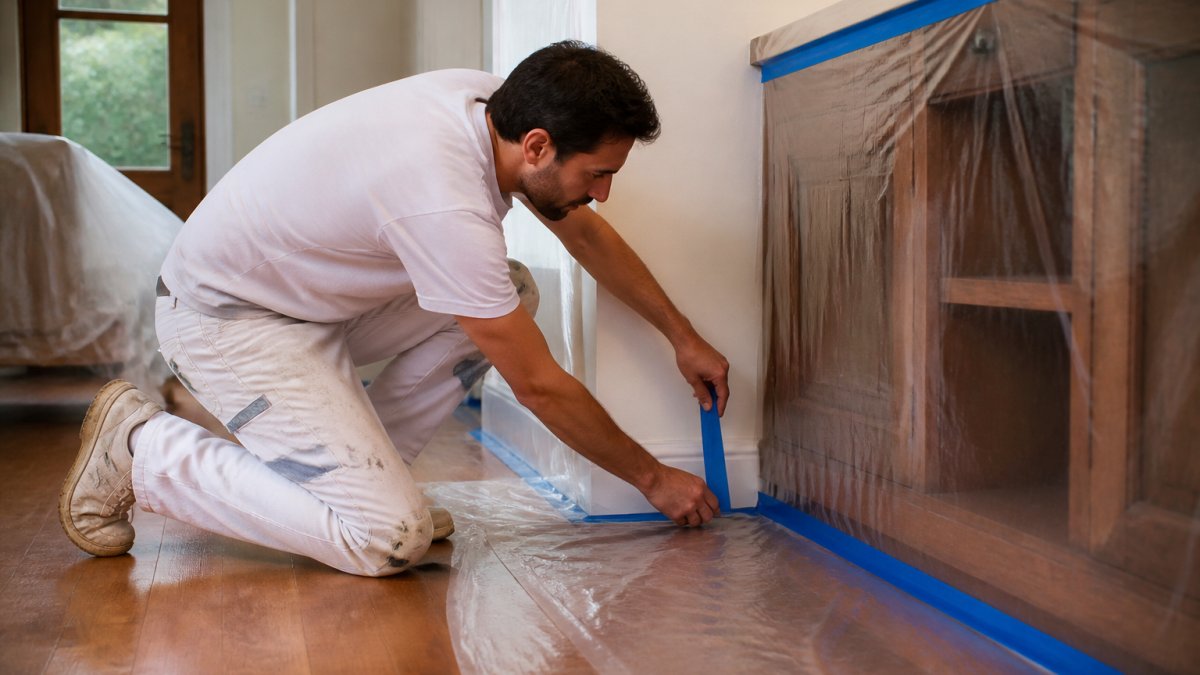
A professional painter spends as much time preparing as applying. That’s the difference between a pristine finish and a disaster.
Proper masking means protecting everything you don’t want painted. This includes:
- Windows and glass
- Trim, architraves, and skirting
- Light switches and power points
The Colour Palette protects every surface meticulously with heavy-duty drop sheets, plastic sheeting, and quality masking tape.
Inadequate masking creates overspray that settles on surfaces you didn’t intend to paint, fine mist can travel metres.
Surface preparation matters too: remove dirt, dust, and loose paint; fill holes and cracks; sand glossy surfaces so new paint adheres.
Spray Painting Kitchen Cupboards: Precision and Durability
Kitchen cupboards are where spray painting proves its worth.
Brush or roller work on cupboards leaves visible marks, uneven coverage, and a hand-painted look.
Professional painters use light, even passes at a consistent distance.
On kitchen cupboards, durability is critical. They’re opened and closed thousands of times and exposed to steam, grease, and moisture.
This is why homeowners in Sydney renovating kitchens choose professional spray application. It’s not just about appearance, it’s about a finish that lasts.
The Real Cost-Benefit: Labour Time and Paint Consumption
Most articles compare sprayers and rollers on application speed alone. That’s misleading, application is only one part of the job. The honest comparison is total job time (prep, masking, application, cleanup) and material use per finished square metre.
Total job time, not just spray time
Here’s how time typically splits on a mid-sized interior repaint. Figures are illustrative proportions, not fixed numbers, every job differs.
| Stage | Roller and brush | Airless sprayer |
|---|---|---|
| Surface prep (filling, sanding, cleaning) | Same | Same |
| Masking and containment | Light, edges and floors | Heavy, full room isolation, fixtures, trim, floors |
| Application | Slower, multiple passes, cutting in | Much faster on flat and textured surfaces |
| Cleanup | Roller covers, trays, brushes | Flush lines, gun, tip, filters, remove masking |
On a single bedroom, masking and cleanup overhead can exceed the application time saved, making a roller faster overall.
The crossover point is usually around 40-100 square metres of paintable surface, but it shifts with geometry: lots of flat wall pushes it lower; lots of trim, fixtures, and furniture pushes it higher.
The right question isn’t “which method applies paint faster?” It’s “which method finishes the whole job, prep to cleanup, in less time and with less rework?”
Paint consumption: where the extra goes
A sprayer uses more paint than a roller, but the reason matters more than the amount.
- Overspray loss. Atomised paint that misses the surface is the main source of waste. In a well-masked interior with still air, loss is modest. On an exterior job in wind, loss rises sharply.
- Transfer efficiency. How much of the atomised paint actually lands on the target depends on gun distance, tip size, pressure, and technique. A painter who holds the gun too far away wastes paint; one who holds it correctly wastes very little.
- Viscosity and thinning. Some coatings need thinning to spray correctly. Over-thinning reduces film build and can mean an extra coat, which erases any material saving.
Typically, spraying uses around 5-15% more paint than rolling on a contained interior job, and considerably more on exposed exterior work. That extra material cost is small next to labour time saved on a large job, but on a small job it can tip the economics back toward rolling.
Cost per finished square metre
The most useful comparison is cost per finished square metre, combining:
- Material cost, paint volume used, including overspray and any extra coat from thinning.
- Labour cost, total hours at the applicable rate, from setup through cleanup.
- Consumables, masking film, tape, drop sheets, tips, filters, roller covers.
- Rework risk, the cost of fixing runs, dry spray, uneven coverage, or overspray damage.
On large, simple surfaces, spraying usually produces the lowest cost per finished square metre because labour dominates and spraying slashes labour hours. On small or complex jobs, rolling often wins because material waste and masking overhead dominate.
Where the finish quality changes the maths
On some jobs, the finish spec decides, not cost per square metre. Kitchen cupboard doors, heritage joinery, and high-end commercial fit-outs often require a film quality brush and roller work can’t reliably deliver. There, spraying is justified by avoiding rework and meeting spec first time, not by labour savings.
Don’t compare a sprayer’s paint use to a roller’s in isolation. Compare the total cost of the finished job, including the labour hours you’d spend masking, applying, cleaning, and fixing defects. That’s the number that actually decides which method is cheaper.
A practical way to estimate
Before choosing a method, sketch out:
- Total paintable area in square metres.
- Estimated masking and containment hours.
- Estimated application hours for each method.
Run the numbers on both methods. On most jobs over roughly 100 square metres, spraying comes out ahead. Below that, it depends on geometry and finish requirements. Professional painters make this calculation on every job, it’s why they reach for a sprayer on some projects and a roller on others, and why the decision is never automatic.
Frequently Asked Questions
Why do professional painters use paint sprayers instead of brushes and rollers?
Professional painters use sprayers because they deliver consistent finish quality, cover large surfaces three to five times faster than rollers, and create a smooth, even coating with minimal brush marks or roller stipple. Sprayers apply paint in a fine mist that bonds uniformly to the surface, which is especially critical for heritage finishes, commercial spaces, and kitchen cupboards where durability and appearance matter. The spray application also reaches corners, edges, and textured surfaces more effectively than manual tools.
How does spray painting compare to rolling when it comes to finish quality?
Spray application produces a superior finish because the paint atomises into tiny droplets that settle evenly across the surface, creating consistent film thickness and opacity without visible application marks. Rollers leave a stippled texture and require multiple coats to achieve uniform coverage. Sprayers eliminate lap marks and provide the smooth, professional finish that homeowners and commercial clients expect. This advantage is particularly noticeable on kitchen cupboards, feature walls, and exterior cladding where the finish is visible from all angles.
What preparation work is required before spray painting to protect floors and furniture?
Proper masking is essential before spray application. This includes laying protective sheeting over floorboards and furniture, taping around trim, windows, and fixtures, and sealing off areas where overspray could settle. Professional painters use heavy-duty plastic and painter’s tape to create a complete barrier, preventing paint mist from landing on surfaces outside the target area. This preparation typically takes 30-60 minutes depending on room complexity, but it ensures a clean, stress-free result and protects your property during the painting process.
Are paint sprayers suitable for spray painting kitchen cupboards?
Yes, spray painting is the preferred method for kitchen cupboards because it delivers a durable, factory-finish appearance that brush or roller application cannot match. Sprayers create a thin, even coating that resists chipping and peeling, which is critical in high-traffic kitchen environments. The spray application also eliminates brush marks and provides superior adhesion to cabinet surfaces. Professional spray painters use proper surface preparation, primer, and topcoat systems specifically designed for kitchen cupboards to ensure long-term durability and a finish that looks pristine for years.