

Oct 2026 How to Estimate Residential Painting Costs Accurately
Table of Contents
- What a Residential Painting Estimate Actually Includes
- Step 1: Measure the Paintable Area of Every Surface
- Step 2: How to Calculate Paint Quantity for the Job
- Step 3: Estimate Labour Time and Hourly Rates
- Step 4: Use a House Painting Cost Calculator to Cross-Check
- Step 5: Cost to Paint a Three-Bedroom House Interior
- Step 6: Run Through a House Painting Quote Checklist
- Common Mistakes That Throw Off a Residential Painting Estimate
- Frequently Asked Questions
Last Updated: October 12, 2026
What a Residential Painting Estimate Actually Includes
A residential painting estimate is a written breakdown of every cost tied to your job: labour, materials, preparation and overhead, added together into one figure. Knowing how to estimate residential painting costs means understanding each part, not just the final number. This guide from The Colour Palette walks through the whole method, step by step.
Most homeowners only see the total. That’s the problem.
Two quotes can land thousands apart because one painter includes proper surface preparation and the other skips it. Same walls, different job.
Labour, Materials, Preparation and Overhead
Every painting estimate splits into four buckets:
- Labour: painter hours multiplied by an hourly rate
- Materials: paint, primer, tape, filler, sandpaper, drop sheets
- Preparation: sanding, patching, filling cracks, masking
- Overhead: travel, insurance, equipment wear, admin
Preparation is the sneaky one. A wall in good nick might need an hour of sanding. A wall with peeling paint and hairline cracks can eat a full day.
If a quote doesn’t break out preparation separately, ask why. It’s usually buried in the labour line, and that hides how much sanding and repair you’re actually paying for.
Step 1: Measure the Paintable Area of Every Surface
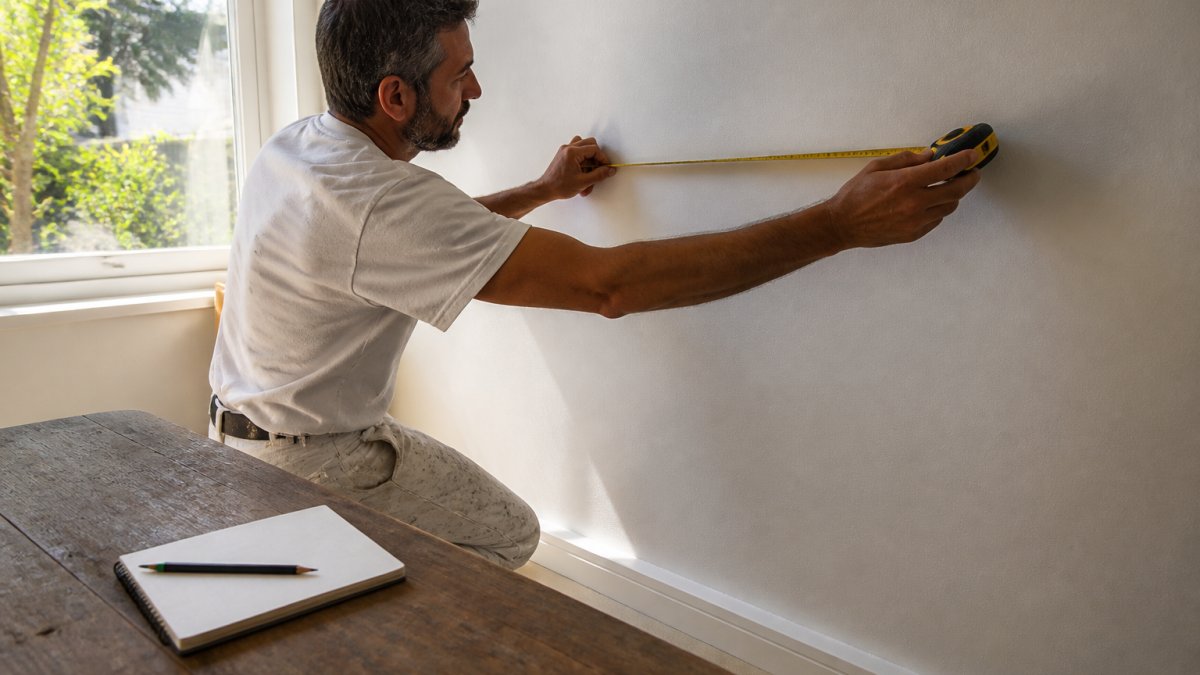
Measure each wall’s height and width in metres, multiply them together, then subtract the area taken up by doors and windows. That gives you the paintable area for that surface.
Here’s how to work through a room:
- Measure wall length and ceiling height in metres
- Multiply length by height for each wall
- Add all walls together
- Subtract roughly 1.8 square metres per standard door
- Subtract roughly 1.5 square metres per standard window
Walls, Ceilings, Trim, Doors and Windows
Walls are the easy part. The fiddly surfaces are where estimates go wrong.
- Ceilings: same length by width maths, but slower to paint overhead
- Trim and skirting: measure linear metres, not square metres
- Doors: count each one, both sides plus edges
- Windows: count frames and sills separately from glass
Trim work takes longer per square metre than a flat wall. A room with heavy decorative moulding can add hours.
Step 2: How to Calculate Paint Quantity for the Job
To calculate paint quantity, divide your total paintable area by the coverage rate on the tin, then multiply by the number of coats. Most interior paints cover around 10 to 16 square metres per litre, but always check the label.
A 40 square metre room with two coats at 12 square metres per litre needs roughly 6.7 litres. Round up. You’ll want spare for touch-ups.
Coverage Rates, Coats and Primer
Three things change your paint quantity fast:
- Colour change: going from dark to light often needs an extra coat
- Surface texture: rough or porous surfaces drink more paint
- Primer: bare plaster, timber and repaired patches need a primer coat first
Buy all your paint in one batch. Tins from different batches can vary slightly in colour, and on a large wall that difference shows up in raking light.
Step 3: Estimate Labour Time and Hourly Rates
Labour is usually the biggest line in any painting quote, so this is where your estimate lives or dies. A painter’s hourly rate covers their time, insurance, equipment, travel and admin, which is why it sits well above a simple wage figure.
To estimate labour hours, you need a production rate for each surface type: how many square metres (or linear metres, or units) a painter covers per hour. These rates vary, but common working figures are:
| Surface | Typical production rate | Notes |
|---|---|---|
| Walls, rolled | 15-25 m² per hour | Slower if patching or cutting in around obstacles |
| Ceilings | 10-18 m² per hour | Overhead work, more fatigue, more repositioning |
| Trim and skirting | 6-10 linear metres per hour | Cutting in by hand, two coats |
| Doors | 0.5-1 hour per door | Both sides plus edges, hardware removed |
| Windows | 0.5-1 hour per window | Frames, sills, masking |
Then add preparation time on top. A common mistake is estimating paint time only and forgetting the sanding, filling and masking that comes first.
Worked example: a 4 m × 5 m bedroom
Take a bedroom with 4 m walls, a 2.7 m ceiling, one standard door and one standard window.
At two coats and a mid-range production rate of 20 m² per hour for walls, that’s 39.9 × 2 ÷ 20 ≈ 4 hours.
Add preparation. If the walls are in good condition, budget 2-3 hours for light sanding, filling and masking.
Multiply by your local hourly rate. At $65 per hour, that’s roughly $1,000 in labour for one bedroom. At $45 per hour, about $690. At $90 per hour, about $1,390.
Ask each painter for their hourly rate and their estimated hours separately. A quote that only gives a lump sum hides whether you’re paying for speed or for thoroughness, and it makes comparing two quotes almost impossible.
Why the rate matters as much as the hours
A cheap hourly rate with slow production can cost more than a higher rate with fast, clean work. Two painters quoting the same job at $50 and $75 per hour might land within $100 of each other once hours are factored in.
Also watch for minimum call-outs, travel charges and after-hours rates. Many painters charge a minimum of two to four hours for small jobs, and some add a travel fee outside a certain radius.
Step 4: Use a House Painting Cost Calculator to Cross-Check
A house painting cost calculator gives you a rough figure in seconds, and that’s exactly what it’s for: a sanity check, not a final quote.
Plug in your room count, ceiling height and surface condition. Compare the result against your own hand calculation. If they’re wildly different, find out why before you talk to a painter.
Calculators miss things a real estimate catches:
- Access issues like stairwells or high ceilings
- Heritage detailing that needs special handling
- Furniture moving and floor protection
- Colour changes that add coats
Treat the calculator as a second opinion. Your measurements are the primary source.
Step 5: Cost to Paint a Three-Bedroom House Interior
The cost to paint a three-bedroom house interior depends on size, ceiling height, surface condition and how much preparation is needed. A well-maintained home with standard ceilings sits at the lower end; a home needing repairs, patching and multiple colour changes sits at the higher end. Rather than quote a single figure, build your own range using the method below, that range is far more useful than any generic number you’ll find online.
A worked estimate for a typical three-bedroom home
Assume a single-storey home of about 120 m² of floor area, with three bedrooms, a living area, a hallway, a kitchen and one bathroom. Ceilings are 2.4 m.
Using the production rates from Step 3:
| Component | Quantity | Hours (approx.) |
|---|---|---|
| Walls, rolled, two coats | ~280 m² | 28 |
| Ceilings, two coats | ~110 m² | 16 |
| Trim and skirting | ~90 linear m | 22 |
| Doors, both sides | 8 | 6 |
| Windows | 10 | 7 |
| Preparation (light patching, sanding, masking) | , | 12 |
| Total labour | ~91 hours |
At $65 per hour, labour comes to roughly $5,900. Materials, paint, primer, tape, filler, sandpaper, drop sheets, for a home this size typically run $1,200 to $2,000 depending on brand and how many coats.
That’s a mid-range figure. A smaller home in good condition with standard ceilings might land closer to $5,500.
What pushes the estimate up or down
- Ceiling height: anything above 2.7 m slows the work and often needs scaffolding or a taller ladder.
- Surface condition: peeling paint, water stains, cracks and previous failed coatings add preparation hours, sometimes doubling them.
- Number of coats: a colour change from dark to light, or a switch between very different tones, often needs an extra coat.
- Access: stairwells, tight hallways and rooms packed with furniture all slow production.
- Trim complexity: decorative moulding, picture rails and multiple window panes add hours per unit.
- Timing: peak season and short-notice jobs attract higher rates.
Build your range from your own measurements, not from a national average. A three-bedroom home in one suburb can cost half what an identical home costs in another, purely because of local labour rates and access.
Turning the estimate into a quote
When you request quotes, give each painter the same information: room count, approximate wall and ceiling area, ceiling height, surface condition, whether you want ceilings and trim included, and how many coats. That way you’re comparing equivalent scopes.
For a firm figure on your own property, request an on-site assessment. A written quote based on a walkthrough will always beat a phone estimate, because the painter can see the patching, the access and the condition of every surface before committing to a number.
Step 6: Run Through a House Painting Quote Checklist
A house painting quote checklist helps you compare quotes fairly and spot what’s missing. Ask every painter the same questions and compare the answers side by side.
- Is preparation listed separately, with what’s included?
- How many coats are quoted, and which paint brand?
- Are doors, windows and trim included or extra?
- Is furniture moving and floor protection covered?
- What’s the payment schedule and deposit?
- Is there a written scope and timeline?
- What happens if the finish isn’t right?
- Are repairs and patching included or quoted separately?
The cheapest quote is often the one with the most exclusions. If preparation isn’t listed, you may be paying for it later as a variation, at whatever rate the painter sets.
Common Mistakes That Throw Off a Residential Painting Estimate
The biggest mistake is estimating paint and labour while ignoring preparation, access and contingency. Those three items are where budgets blow out.
Other traps we see often:
- Measuring floor area instead of wall area
- Forgetting ceilings entirely
- Assuming one coat covers a colour change
- Skipping the primer on bare or repaired surfaces
- Not adding a contingency for hidden damage
A realistic estimate includes a buffer. If you find rot, water damage or failed previous coatings, the job grows. Budget for it upfront and you won’t be shocked later.
For accurate painting costs on your own home, get a proper on-site assessment rather than relying on guesswork.
Frequently Asked Questions
How many litres of paint do I need for a house?
Paint quantity depends on the total paintable area and the number of coats. A standard interior door has about 2 square metres per side, and a window frame around 1.5 linear metres. Most interior emulsion covers 10 to 14 square metres per litre per coat. For a three-bedroom house with roughly 200 square metres of wall and ceiling, you might need 30 to 40 litres for two coats. Always add 10% for touch-ups and waste.
What factors affect a residential painting estimate?
Several factors change the final figure: the condition of the surfaces (repairs, sanding, filling), the number of coats required, access equipment for high ceilings or exteriors, the type of paint specified, and the time of year (weather for exterior work). Labour rates also vary by region and painter experience. Preparation often takes longer than painting itself, so a thorough estimate must account for it.
What should a house painting quote include?
A detailed quote should list surface preparation (sanding, filling, priming), the number of coats, the brand and type of paint, labour hours, protection of floors and furniture, clean-up, and any exclusions. It should also state whether the price includes GST and whether a deposit is required. Ask for a written scope so you can compare quotes fairly. A low quote may exclude preparation, leading to poor results.
How much does it cost to paint a three-bedroom house interior?
Painting a three-bedroom house interior typically involves walls, ceilings, trim, doors, and windows. Costs vary widely based on ceiling height, surface condition, and whether you choose a standard repaint or a full preparation. Professional painters might charge based on square metreage or hourly rates. For an accurate figure, use a cost calculator or request a detailed quote from a local painter.
Estimating a paint job well comes down to measuring carefully, costing each stage honestly, and leaving room for surprises. If you’d rather skip the maths, The Colour Palette offers on-site assessments, detailed written quotes, expert colour consultation and careful protection of your home throughout the job. Get started with The Colour Palette and receive an online quote for your next project.