

Sep 2026 Commercial Painting Services With Minimal Disruption
Table of Contents
- What Minimal Disruption Actually Requires From Commercial Painting Contractors
- Staged Works vs Full Closure: A Cost-Benefit Comparison
- After-Hours Commercial Painting Services: When They Pay Off
- How to Prepare Your Office for Painting: A Zone-by-Zone Checklist
- Inside a Commercial Painting Project Timeline
- Low-VOC Paints, Site Safety and Health Requirements
- Insurance, Warranties and Verifying a Contractor Before Work Starts
- Frequently Asked Questions
Last Updated: September 13, 2026
What Minimal Disruption Actually Requires From Commercial Painting Contractors
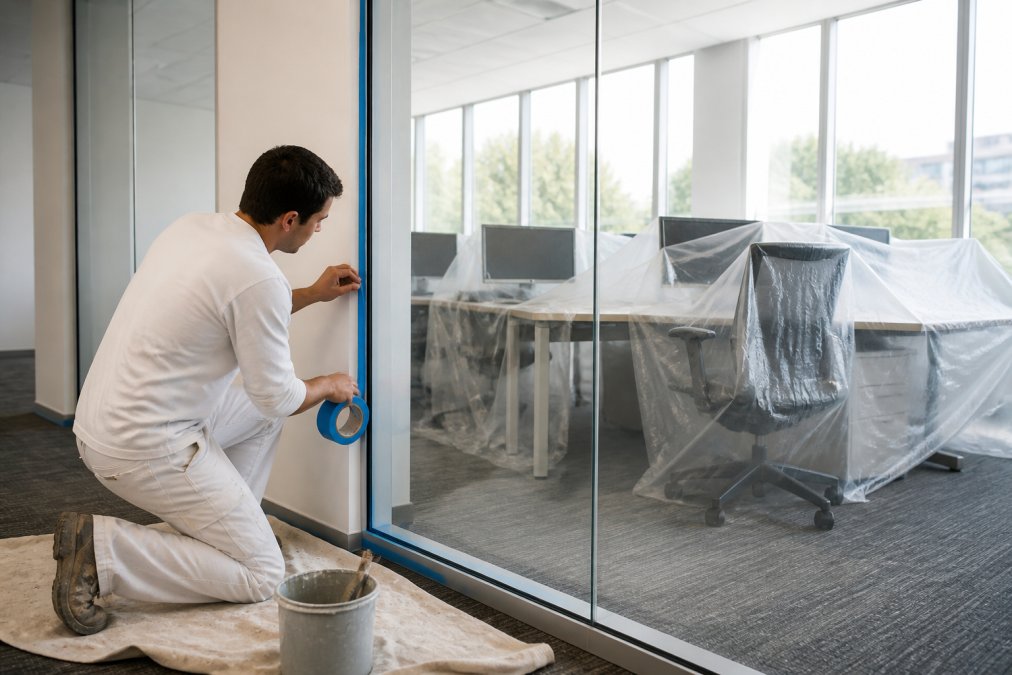
Commercial painting services with minimal disruption means scheduling work around your trading hours, isolating each zone so the rest of the site keeps running, and protecting everything that isn’t being painted. At The Colour Palette, we’ve spent over 20 years refining that approach across offices, retail spaces, cafes and heritage buildings.
Here’s the uncomfortable truth most quotes skip over: the painting itself is rarely the problem. The disruption comes from poor sequencing, unprotected floors, and crews who treat your workplace like an empty construction site.
The Real Cost of a Closure
Closing a venue for a week costs far more than the paint job. You lose trading revenue, staff hours, bookings and momentum, and none of that appears on a painter’s quote. A staged program that runs after hours usually costs more in labour but protects the income the space generates. That trade-off is the whole game.
The most expensive mistake is choosing a contractor on price alone. A cheaper quote that stretches a job from three nights to two weeks quietly costs you more in lost trade than the difference you saved.
Staged Works vs Full Closure: A Cost-Benefit Comparison
Staged works split a project into zones so part of the business stays open throughout. Full closure gets the job done faster but stops all revenue for the duration. Which one wins depends on your margins, your lease terms and how visible the work is to customers.
| Factor | Staged Works | Full Closure |
|---|---|---|
| Trading during project | Continues in unaffected zones | Stops entirely |
| Total project duration | Longer | Shorter |
| Labour cost | Higher (after-hours rates) | Lower |
| Customer experience | Mostly uninterrupted | Interrupted |
| Best for | Retail, cafes, offices | Vacant fit-outs, warehouses |
The Calculation Most Quotes Don’t Show You
A cost-benefit comparison only means something when you put your own numbers into it. The framework is straightforward: compare the extra labour cost of staged or after-hours work against the gross profit your business would lose during a full closure.
Work through it in four steps:
- Estimate your daily gross profit for the space being painted, revenue minus the direct cost of goods or services, not total revenue.
- Estimate the closure duration a full-closure program would need, including prep, cure time and handover.
- Multiply the two to get the revenue at risk from closing.
- Compare that figure against the premium a staged or after-hours program adds to the painting quote.
If the revenue at risk is larger than the staged premium, staged works wins on pure economics. If it’s smaller, as it often is for a back-office area with no customer footfall, full closure is the rational choice and you should take the faster, cheaper option.
Where the Numbers Get Complicated
Three factors push the calculation away from the simple version:
- Lease obligations. Some commercial leases require you to maintain trading hours or keep the premises in a presentable state. Check your lease before assuming full closure is available to you.
- Staffing. If you keep staff on during a closure, you’re paying wages against zero revenue. That cost belongs in the ‘revenue at risk’ side of the ledger, not the painting quote.
- Customer habit. A venue closed for a week doesn’t always recover its regulars immediately. The momentum loss is real but hard to quantify, so treat it as a reason to lean toward staged works when the two options are close.
Staged works isn’t automatically the ‘professional’ choice, it’s the choice that wins when your daily gross profit is high relative to the labour premium. Run the four-step calculation before you decide, and ask your contractor to quote both options so you’re comparing like with like.
For a cafe turning over steady daily revenue, staged works almost always wins. For a vacant tenancy being fitted out before opening, full closure is faster and cheaper. The difference is whether the space is generating income while the painters are in it.
After-Hours Commercial Painting Services: When They Pay Off
After-hours commercial painting services pay off when your revenue per trading hour exceeds the extra labour cost of night or weekend work. For hospitality and retail, that’s usually true. For back-office spaces, daytime staged work is often the smarter call.
Night crews need clear access, working lighting and a site contact. Confirm who holds keys, when alarms get disarmed, and how waste leaves the building. Get those three things wrong and a smooth program stalls on night one.
How to Prepare Your Office for Painting: A Zone-by-Zone Checklist
Preparing an office for painting starts with mapping zones and clearing each one the night before its scheduled slot. The less a crew has to move, the faster they work and the less they disturb. But the work that protects your schedule happens in the fortnight before anyone picks up a brush, not the night before.
Two Weeks Out: Planning and Access
- Agree the zone map in writing. Each zone needs a name, a scheduled paint date and a clear boundary. Ambiguous zones are the single most common cause of a staged program slipping.
- Confirm access arrangements. Who holds keys, when alarms are disarmed and rearmed, which lifts or stairs the crew can use, and where vehicles can park and load. Get this in writing, not over the phone.
- Book the loading dock or goods lift if your building shares one. In multi-tenancy buildings, dock time is often the real bottleneck, not painter availability.
- Check building management requirements. Many commercial buildings require contractors to be inducted, to sign in, and to provide public liability certificates and safe work method statements before site access is granted. Start this paperwork early, it can take days.
- Notify neighbouring tenants if shared walls, corridors or services are affected. A five-minute email prevents a complaint that stalls the job.
One Week Out: Staff and Assets
- Brief staff on the zone schedule so they know which areas are off-limits on which days, and where they’ll be working instead.
- Assign one internal contact per zone. This person answers the crew’s questions on the night and signs off the zone when it’s done. Without a named contact, decisions stall.
- Identify anything fragile or fixed, wall-mounted screens, whiteboards, artwork, security cameras, sensors, data points, air-conditioning controllers. These need to be removed by a qualified person or masked with care.
- Plan where cleared furniture and equipment will go. Stacking it in the next zone just moves the problem. Book a genuinely out-of-the-way holding area.
- Arrange IT support if cabling, data points or mounted equipment need to be disconnected and reconnected. Don’t leave this to the painting crew.
The Night Before Each Zone
- Label the zone with its scheduled paint date so the crew can confirm they’re in the right place.
- Clear desks, wall-mounted screens and whiteboards.
- Remove or cover IT equipment and cabling.
- Empty kitchenettes and lock away food.
- Confirm parking and loading access for the crew.
- Confirm the internal contact for that zone is reachable.
What to Leave to the Contractor
Preparation isn’t all yours. A professional crew should handle surface cleaning, sanding, filling, masking of edges and floors, and protection of fixed surfaces within the zone. What they can’t do is move your business out of the way, that’s the part only you can plan.
Ask your contractor for a written zone schedule at least a week before work starts. If they can’t produce one, the ‘minimal disruption’ promise is aspirational rather than planned.
Inside a Commercial Painting Project Timeline
A commercial painting project timeline typically runs from site assessment through preparation, painting and a final inspection, with each stage gated so the next zone only starts once the previous one is signed off. Rushing the prep stage is the single biggest cause of callbacks.
- Site assessment and colour consultation (1-2 weeks before start)
- Surface preparation and repairs (per zone)
- Masking, protection and priming (per zone)
- Topcoats and cutting in (per zone)
- Inspection, touch-ups and handover
What Slows a Timeline Down
Three things blow out timelines more than anything else: hidden surface damage, colour changes mid-project, and access restrictions. A wall that looks fine under office lighting can reveal cracks, water staining or old wallpaper once prepped. Build a contingency into the schedule rather than assuming the best case.
Low-VOC Paints, Site Safety and Health Requirements
Low-VOC paints reduce fumes and let occupied spaces return to normal use faster, which matters most in enclosed offices, clinics and hospitality venues (the EPA). Ask your contractor which products they’ll use and whether they suit occupied-space work.
Site safety on a commercial job covers more than paint. Under Safe Work Australia’s model WHS laws, duty holders must manage risks from fumes, working at height, electrical hazards and manual handling. A contractor without a documented safety method is a liability you don’t want on your site.
Ask for the safety data sheets for every product before work starts. It takes two minutes and tells you exactly what’s being applied in your space.
Insurance, Warranties and Verifying a Contractor Before Work Starts
Verifying a contractor means checking three documents before anyone picks up a brush: public liability insurance, a workmanship warranty, and current licensing. Public liability insurance protects you if a crew member damages property or injures someone on site (business.gov.au). A workmanship warranty is your only real recourse if the finish fails.
Ask to see the certificate of currency directly, not a verbal assurance. Confirm what the warranty actually covers and for how long, and get it in writing. If a contractor hesitates on any of these, walk away.
Frequently Asked Questions
How long does a commercial painting project typically take?
Most commercial interiors take one to three weeks of on-site work, depending on floor area, how many coats are needed and whether the space has to stay open. A single office floor of around 500 square metres usually runs five to eight working days with a small crew. Staged works add calendar time because each zone is finished and handed back before the next begins, but the total hours on the tools stay similar.
Do commercial painting contractors work after hours to avoid business downtime?
Many do, and after-hours commercial painting services are common for retail, hospitality and office fit-outs where daytime closure is not an option. Crews typically work evenings, overnight or weekends, then hand the space back before opening. Expect a loading on the quoted rate for unsociable hours, and check that the contractor can access lifts, power and parking outside normal building hours before the schedule is locked in.
What safety standards must commercial painters follow?
Commercial painting work is covered by work health and safety legislation in each state and territory, plus the model Code of Practice for construction work. In practice that means site-specific inductions, safe work method statements for high-risk tasks, working at height controls for ladders and elevated platforms, and material safety data sheets for every coating on site. Contractors should also hold current public liability insurance and, where required, workers compensation cover.
How much should I expect to pay a painter per day?
Rates vary with the market, the complexity of the site and the hours worked, so treat any single figure with caution. Pricing for a commercial repaint depends on floor area, surface condition, access equipment, paint specification and whether work happens after hours. Ask for a written scope that separates preparation, coating and making good, then request a quote based on your actual site rather than a square-metre rule of thumb.
Choosing a commercial painter comes down to one question: can they keep your business running while they work? The Colour Palette has handled commercial projects across offices, retail and hospitality for over 20 years, with meticulous protection of floors and furniture, staged scheduling built around your trading hours, and expert colour consultation so the finish is right the first time. Get an online quote from The Colour Palette and keep your doors open while the work gets done.