

Sep 2026 Strata Building Exterior Maintenance Painting Sydney
Table of Contents
- Why Strata Exterior Painting Is More Than a Refresh
- Strata Painting Maintenance Schedule: How Often to Repaint
- Strata Painting Compliance NSW: Rules and Responsibilities
- Cost of Strata Building Painting: What Drives the Quote
- Selecting Strata Painting Contractors: A Tender Checklist
- The Strata Painting Process: From Inspection to Handover
- Protecting Your Asset: Long-Term Benefits of Planned Maintenance
- Frequently Asked Questions
Last Updated: September 7, 2026
Why Strata Exterior Painting Is More Than a Refresh
Strata building exterior maintenance painting sydney is the systematic process of repainting and restoring the external surfaces of multi-unit residential complexes, including facades, common areas, and structural elements. Most committees treat it as a cosmetic upgrade, but in practice it functions as the primary defence against weather damage, concrete spalling, and premature building decay. At The Colour Palette, we have over 20 years of industry experience in residential and commercial painting solutions.
The cost of deferring this work compounds quickly. Water ingress through a cracked facade does not just ruin paint; it accelerates concrete spalling and corrosion protection failure, turning a routine repaint into remedial painting that costs several times more. A proactive exterior painting program keeps the building weatherproof, preserves its value for owners, and avoids the emergency levies that no owner wants to see.
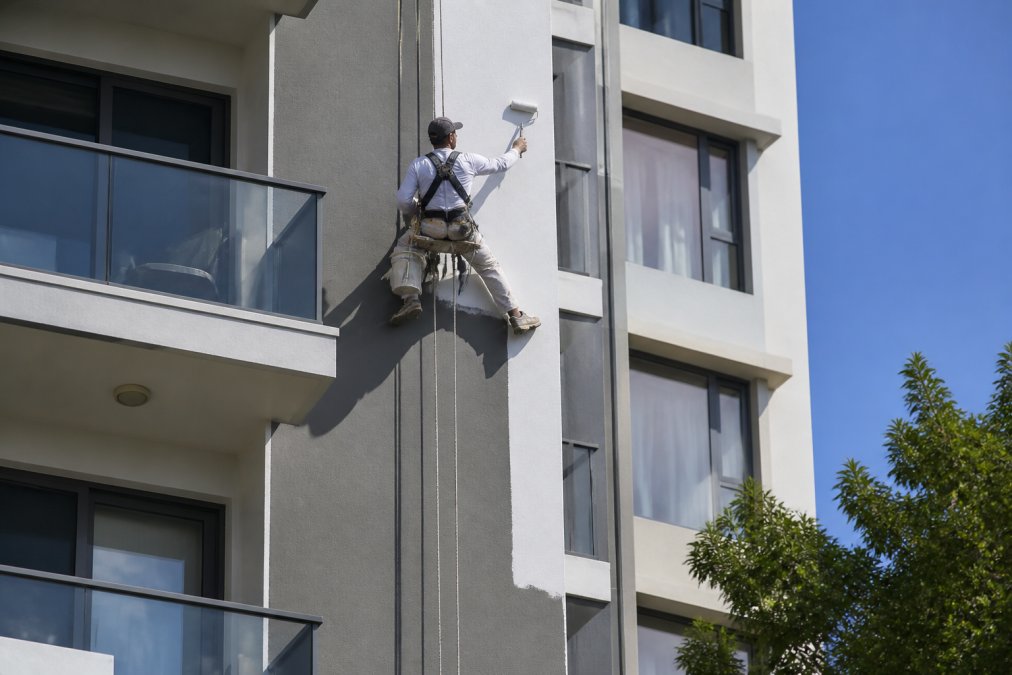
Below, we break down the schedule, the legal obligations, the cost drivers, and the exact process of selecting and managing a contractor, so your committee can plan with confidence rather than react in a crisis.
Strata Painting Maintenance Schedule: How Often to Repaint
A typical strata building exterior maintenance painting schedule recommends repainting every 7 to 10 years, though coastal exposure, orientation, and paint quality can shorten that cycle (nasa.gov).
High-access areas and surfaces facing harsh weather will degrade faster, meaning a single schedule for the whole complex rarely works. Most professional assessments split the building into zones: the exterior facade may need attention at the 7-year mark, while sheltered common property such as car parks and stairwells can stretch to 12 years.
| Building Zone | Typical Repaint Cycle | Key Risk If Deferred |
|---|---|---|
| Exterior facade (weather-exposed) | 7-10 years | Water ingress, concrete spalling |
| Car parks and epoxy flooring | 8-12 years | Corrosion, line marking fading |
| Common areas (lobbies, corridors) | 5-8 years | Wear, loss of asset appeal |
| Timber and heritage elements | 3-5 years | Rot, termite damage |
The trigger for repainting should never be purely cosmetic. Once you see cracking, chalking, or blistering, the protective coating has already failed and the substrate is at risk. A common mistake is repainting over a failing surface to save money; the new coating fails within two years because the preparation was skipped.
Do not repaint over failing paint. Surface preparation is the difference between a coating that lasts a decade and one that peels within two years. Skimping here is the most expensive saving a committee can make.
Strata Painting Compliance NSW: Rules and Responsibilities
Navigating the legal framework for strata painting in NSW involves strict governance for funding, a clear understanding of common property rights, and adherence to safety regulations with significant penalties for non-compliance.
The Foundation: The Strata Schemes Management Act 2015
The Strata Schemes Management Act 2015 (SSMA) dictates that the owners corporation is responsible for maintaining common property, including the external facade, roof, and structural walls. Before any work begins, the committee must obtain approval via a motion at a general meeting. The critical financial step is often overlooked: the Capital Works Fund (sinking fund) plan.
Under the SSMA, the owners corporation must have a 10-year Capital Works Fund plan that anticipates major expenses like facade repainting and sets levy contributions accordingly (nsw.gov.au). An inadequate plan requiring a special levy for urgent painting signals poor financial governance and can cause disputes. A proactive committee reviews this plan annually to align with the 7-10 year repaint cycle.
The Financial Governance of a Painting Project
When a painting project is approved, funds must be sourced correctly. If the Capital Works Fund lacks sufficient balance, the committee must raise a special levy, which requires:
- Motion at a General Meeting: A motion to raise the levy and authorise the expenditure must be put to a vote.
- Quorum Requirements: The meeting must meet the quorum as defined by the Act for the motion to be valid.
- Levying Owners: Contributions are typically calculated according to a lot’s unit entitlement.
Work undertaken without this formal financial authorisation can leave the owners corporation and individual committee members personally liable for the costs. This is a key risk that many service-provider guides omit.
Mandatory Safety and Compliance Checks
Beyond the SSMA, strict WHS regulations under the Work Health and Safety Act 2011 (NSW) apply. A key compliance point is the Safe Work Method Statement (SWMS), required for high-risk work at height where a person could fall more than 2 metres. The SWMS must be specific to the building and access method (scaffolding, EWP, or abseiling), not a generic template.
Furthermore, if the building has a development application (DA) or is subject to a building bond, there may be additional inspection requirements. For example, if the building is within a heritage conservation area or is itself heritage-listed, the work is not ‘exempt development’. It will likely require a Development Application (DA) to be approved by the local council, which can involve heritage consultants and specific material specifications. The NSW planning portal guidance on exempt and complying development outlines when facade work triggers approval requirements.
The Role of the Building Inspector
A prudent committee commissions an independent building inspection before finalising the scope of works. This report provides an unbiased assessment of the facade, identifying defects like spalling concrete, failed sealants, or rusting reinforcement that must be remediated before painting. It becomes the definitive scope of works, preventing disputes with the contractor and ensuring the tender process compares ‘apples with apples’.
Cost of Strata Building Painting: What Drives the Quote
The cost of strata building painting is driven by access complexity, surface condition, and the extent of preparation, not simply the number of square metres.
Multi-storey buildings require scaffolding, elevated work platforms, or abseiling, each with different cost and disruption profiles. A building with sound paintwork will quote far lower than one needing concrete spalling, crack repair, or failing waterproofing addressed first. Expect the quote to separate preparation from painting, as that is where real cost variation lives.
| Cost Driver | Why It Matters | Impact on Quote |
|---|---|---|
| Access method | Scaffolding vs. abseiling vs. EWP | High |
| Surface condition | Spalling, cracks, failing paint | High |
| Building height and size | Total facade area | Medium |
| Paint system quality | Protective vs. basic coatings | Medium |
Pricing depends on the specific building, its condition, and access requirements. For an accurate figure, request a detailed quote from The Colour Palette after an on-site inspection, as generic estimates rarely reflect the true scope of surface preparation work.
Selecting Strata Painting Contractors: A Tender Checklist
Selecting strata painting contractors requires a structured tender process that evaluates more than the lowest price, because the cheapest quote often omits the preparation work that determines longevity.
Request tender documentation that forces each bidder to itemise surface preparation, paint systems, access methods, and a timeline for minimal disruption. Require evidence of current licences, insurance, and WHS compliance before shortlisting; a contractor who cannot produce these should be excluded immediately.
- Confirm the contractor is licensed and insured for the specific scope
- Request itemised quotes separating preparation from painting
-
- Ask for references from comparable multi-unit complexes
- Verify WHS compliance for high-access work methods
- Review the proposed paint system and warranty terms
Weigh the contractor’s project management capability as heavily as the price. Resident communication, site safety protocols, and a clear handover process separate a smooth project from a protracted dispute.
Ask each tenderer how they will handle resident communication during the project. A contractor with a clear protocol for notifying residents about access, noise, and disruptions will save your committee hours of complaint management.
The Strata Painting Process: From Inspection to Handover
A professional strata painting process begins with a detailed inspection and condition report identifying substrate issues like concrete spalling, crack repair needs, and waterproofing failures before any paint is specified.
The preparation phase involves high-pressure cleaning, removal of failing paint, and repair of damaged surfaces, including applying protective and corrosion coatings to bare metal and concrete. Only then does painting commence, typically in zones to minimise disruption.
The final phase is the handover, including a defects inspection, documented paint system specification, and warranty information. A reputable contractor walks the building with the committee, addressing touch-ups before closing. Clear resident communication about access and noise keeps the project running smoothly.
Protecting Your Asset: Long-Term Benefits of Planned Maintenance
For a strata committee, funding a repaint is often framed as a cost. A more accurate framing is to view it as a capital investment with a measurable return, as this cost-benefit analysis and the sustainability advantages of planned maintenance show.
The Cost-Benefit Analysis: Preventative vs. Reactive
The financial argument for planned maintenance is compelling: small, manageable defects are far cheaper to fix than large, systemic failures.
| Scenario | Typical Action | Relative Cost Factor | Outcome |
|---|---|---|---|
| Planned Maintenance | Repaint facade every 8-10 years, including crack filling and sealant replacement. | 1x (Baseline) | Extends building fabric life, maintains waterproofing integrity, preserves asset value. |
| Reactive Repair (Minor) | Fix a single crack and repaint a small section after a leak is reported. | 1.5x – 2x | Addresses the symptom but often misses the root cause, leading to repeat failures elsewhere. |
| Reactive Repair (Major) | Remediate spalling concrete, replace failed waterproofing membrane, and repaint a large area. | 4x – 6x | Requires extensive scaffolding, specialist trades, longer project timelines, and significant disruption to residents. |
| Emergency Levy | Raise a special levy for urgent, unbudgeted structural repairs. | Variable | Causes financial strain on owners, potential for disputes, and often results in a lower-quality, rushed solution. |
Note: These cost factors are indicative of industry patterns and are intended to illustrate the financial leverage of preventative action. Actual costs vary by building.
The key mechanism is the ‘water ingress cycle’: a small crack allows water to penetrate the concrete, rusting the internal steel reinforcement. Rust expands, exerting pressure from within and causing the concrete to crack and ‘spall’. A $500 crack repair becomes a $50,000 concrete remediation project. Planned maintenance interrupts this cycle at the cheapest possible intervention point.
The Sustainability Angle: Low-VOC and Energy-Efficient Coatings
Sustainability influences property valuation and resident satisfaction. A planned maintenance schedule allows the committee to specify more sustainable products and methods.
- Low-VOC Paints: Traditional solvent-based paints release high levels of Volatile Organic Compounds (VOCs) into the atmosphere. Modern, high-performance low-VOC or zero-VOC acrylic paints are now the industry standard for exterior facades. They offer excellent durability and colour retention while significantly reducing the environmental and health impact during application. Specifying these paints in the tender documents is a simple way to reduce the project’s carbon footprint.
- Energy-Efficient ‘Cool Roof’ Coatings: For flat or low-slope roofs, which are common on strata buildings, reflective roof coatings can be specified. These are designed to reflect a higher percentage of solar radiation than standard dark coatings. By reducing heat absorption, they can lower the internal temperature of the top-floor units, decreasing the load on air-conditioning systems and reducing the building’s overall energy consumption. This is a tangible, long-term operational cost saving for owners.
- Reduced Waste Through Longevity: The most sustainable coating is the one that lasts the longest. A high-quality, correctly applied paint system with a 15-year lifespan is inherently more sustainable than a cheaper system that needs replacing in 7 years. It halves the frequency of full-strip repaints, reducing the volume of paint waste and the resources consumed in scaffolding and labour.
A Strategic Asset Management Tool
A planned maintenance schedule for exterior painting is a core component of a building’s asset management strategy. It provides a predictable financial forecast for the Capital Works Fund, prevents emergency levies, and maintains the building’s appearance and structural integrity. Integrating sustainability criteria into the tender enhances appeal to environmentally conscious buyers and residents, contributing to a higher property valuation for all owners.
Frequently Asked Questions
How often should a strata building be repainted?
A standard exterior repaint cycle for a strata building is every 8 to 10 years, but the exact interval depends on the paint system, exposure to weather, and the condition of the facade. A professional condition assessment can identify whether your building needs attention sooner. Buildings in harsh coastal or high-UV areas may need more frequent maintenance. A strata painting maintenance schedule helps you budget for this recurring cost and avoid the expensive remedial work that comes from letting paint fail completely.
Who is responsible for approving major painting works in a strata scheme?
The owners corporation, acting through the strata committee, is responsible for approving major capital works like exterior painting. The committee should obtain at least two or three detailed quotes, review the proposed scope of work, and check that contractors carry the required licences and insurance. Depending on your scheme’s by-laws and the cost involved, a resolution at a general meeting of owners may be required before work can begin. Proper documentation protects all owners and ensures compliance with NSW strata law.
What safety and compliance standards apply to strata painting projects?
In NSW, all painting contractors must hold a valid contractor licence. Work at height, such as painting upper floors or facades, must comply with WHS regulations, which often means using elevated work platforms or abseiling rather than ladders. Contractors must also provide evidence of public liability insurance and workers compensation. A compliant project includes a site safety plan, proper surface preparation, and waste disposal that meets council requirements. Ask to see these documents before signing any contract.
How does exterior painting impact strata property value?
A well-maintained exterior directly supports property values in a strata scheme. Peeling paint, water stains, and visible concrete spalling signal neglect to potential buyers and can lower sale prices across the whole complex. Planned repainting protects the building fabric from moisture damage, which prevents costly structural repairs later. It also improves kerb appeal, helping individual units sell faster. Regular maintenance is one of the most effective ways an owners corporation can protect the long-term financial value of the asset.
The Colour Palette brings over two decades of experience to strata exterior painting, with meticulous surface preparation, expert colour consultation, and a stress-free process designed around minimal disruption to residents. Our team manages the full scope, from heritage restoration to protective coating systems, ensuring your building is protected and restored to pristine condition. Get started with The Colour Palette and protect your asset with a planned maintenance schedule built to last.